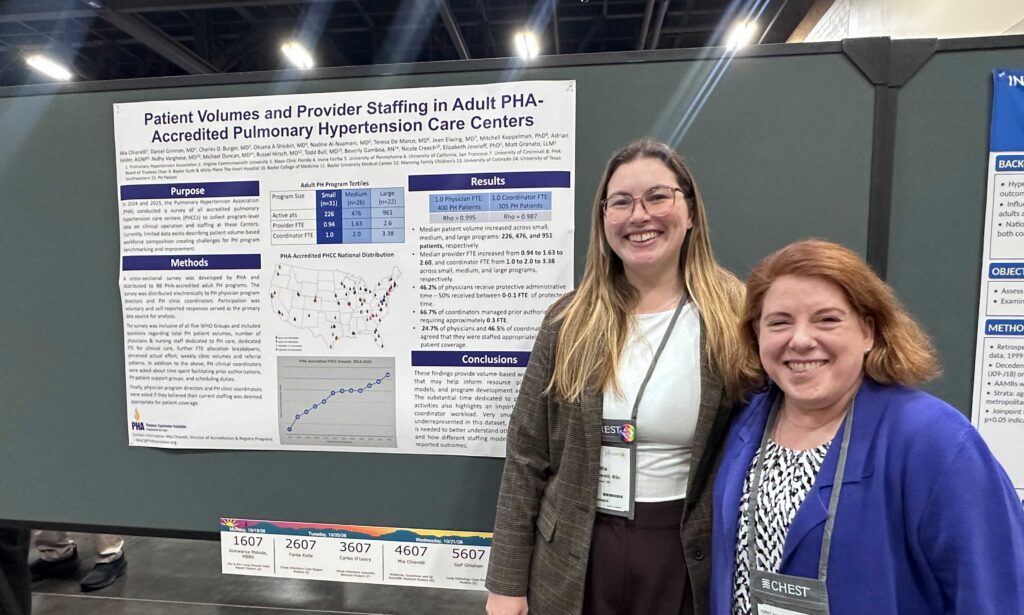
Mia Chiarelli, PHA’s director of accreditation and registry programs, and Elizabeth Joseloff, PhD, PHA’s vice president of Quality Care and Research, at CHEST 2026.
For hospitals and clinics considering becoming PHA-accredited Pulmonary Hypertension Care Centers, newly released survey results will help answer key questions about staffing needs.
The PHA-led survey, “Patient Volumes and Provider Staffing in Adult PHA-Accredited Pulmonary Hypertension Care Centers,” was presented at CHEST 2026, the American College of Chest Physicians’ annual conference. The results also will be published in an upcoming edition of the journal CHEST.
About a decade ago, PHA started the PHCC program to improve the quality of patient care. To be accredited, medical centers are reviewed to ensure they have the resources necessary to treat all forms of pulmonary hypertension. These include a cohesive medical team, verification that diagnoses are made correctly and appropriate treatment is started, and explicit institutional support for the PH program.
But until recently, it wasn’t clear how much staffing was needed to operate a PHCC. The survey data fills that gap, which is useful for all centers, especially those that aren’t yet accredited, according to Mia Chiarelli, PHA’s director of accreditation and registry programs.
“It’s a pretty consistent request that we get from our accredited centers as well as centers that are interested in becoming accredited,” Chiarelli said. “They want to see how their resources compare with those of other centers – to see if they’re on par.”
Survey results
Specifically, the results showed:
- For small programs, the ratio was roughly one full-time coordinator and one full-time provider for about 226 patients.
- For medium programs, that increased to two coordinators and about 1.63 full-time providers for about 476 patients.
- For large programs, staffing averaged about 3.38 coordinators and 2.6 providers for 961 patients on average.

The survey also showed that fewer than half of PH physicians have built-in time for administrative tasks. Among those who do, only about an hour of the workweek was allotted for those tasks.
“That’s not enough time to get all of the administrative hoopla done,” Chiarelli said. “So most of these doctors are working well beyond what would be considered 100% of a full-time employee’s workload.”
Prior authorizations
The survey also revealed that many PH coordinators spend a lot of time seeking health insurance prior authorizations for PH medications and treatments. This cuts into time spent caring for patients.
“There were some coordinators who were spending almost half, if not more than half, of their time dealing with prior authorizations and all that red tape. I think that was really shocking,” Chiarelli said.
For example, a pharmacy tech does PH prior authorizations at the VCU Health PH Care Center in Richmond, Virginia.
“But our coordinators are still spending time trying to do prior authorizations that go beyond what a pharmacy tech can do,” said VCU nurse practitioner Janet Pinson. “So even if you have that help, there’s still so much time spent doing that.”
Pinson, a member of PHA’s PHCC review committee, said the survey helps clinicians on tight budgets make the case for adequate staffing, particularly at smaller centers.
“It’s good for all of us to have a reference point,” she said.
Fun experience
The conference is one of the world’s largest gatherings of pulmonologists and critical care specialists, and Chiarelli was presenting there for the first time. Although she was initially a little nervous, she ended up enjoying the experience.
“There’s a lot of excitement getting this turned into a tool that the centers can use to support their asks and their staffing,” she said. “The pulmonary hypertension community is very welcoming of any information that we’re able to get from our general constituents.”
Read about “The Burden of Prior Authorization for Pulmonary Hypertension Medications: A Practical Guide for Managing the Process” in Advances in Pulmonary Hypertension, Volume 17, issue 3. Advances in PH is the Pulmonary Hypertension Association journal, available online.
View the abstractCategories: