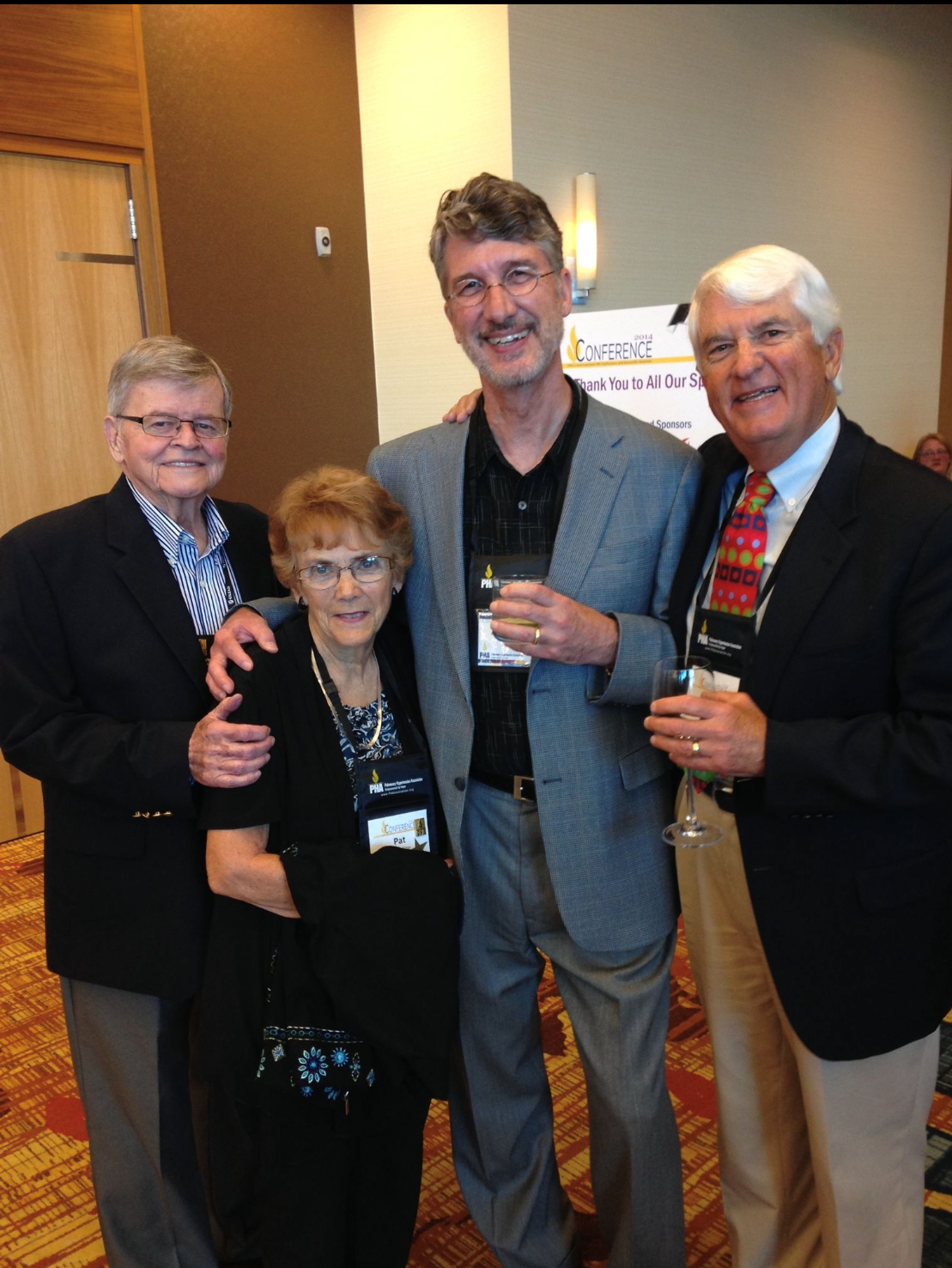
Patricia Rae Berg appeared a bit shy when she was growing up in Logansport, Indiana, but by high school, she already showed the leadership qualities that set her apart.
“She was a determined person,” Judy Simpson says of Pat Paton, her 15-month younger sibling with whom she founded what became the Pulmonary Hypertension Association. “That’s why she survived as long as she did.”
Pat’s journey with pulmonary hypertension began in the late 1970s, about 10 years before her 1987 diagnosis. At the time, she and her husband Jerry were raising their daughter Julie and son Mike in Zionsville, Indiana, an affluent Indianapolis suburb. Pat left her nursing career to manage two Dairy Queen restaurants that had been in Jerry’s family.
They supported the high school students who worked for them with college scholarships. They participated in civic and community organizations.
Pat was known for her innovative approach. When Dairy Queen sent franchisees whole candy bars to break up and mix with ice cream to make Blizzards, Pat triple-wrapped the chocolate in plastic and drove her car over them to break them more easily.
A new challenge
Cardiologist Michael McGoon, MD, met Pat and Jerry when they came to Mayo Clinic in Minnesota after Pat’s diagnosis. Pat was stunned and understandably fearful, McGoon recalls.
“There was no question that the diagnosis was correct and her degree of PH was severe.”
But Pat and her family didn’t see her six-month to two-year prognosis as “an immutable act of fate.” They saw it as a challenge to be addressed head-on.
Judy recalls one of Pat’s questions for the Mayo Clinic doctors. She asked what it would be like if she died of PH. When they told her she probably would die from right heart failure, she didn’t want to drive any more. She was afraid she might injure someone if her heart gave out.
But after 18 months, Judy’s husband, Ed Simpson, asked Pat, “When are you going to start thinking about living, not dying?”
Standing out
In those early visits to Mayo, Pat Paton and McGoon developed what would become a lifetime friendship.
“She would emphasize her wishes and intentions by jabbing her finger at me, often tapping my chest,” McGoon says. “This gesture became a mainstay of our conversations for decades. It unquestionably made a lot of decision-making relatively easy.
I remember once at some event, probably a PHA Conference. The speaker asked Pat to stand from her place in the audience to be recognized, and the petite but feisty lady hollered out, ‘I already am!’
The early years also marked Pat’s desire to meet other people with PH. It took two years to find one – a friend of one of Judy’s nursing students. They met in DeKalb, Illinois, at Judy and Ed Simpson’s house.
Judy, Ed and Jerry could see how important the meeting was to Pat. She had found a kindred spirit.
Dynamic force
When Pat and Jerry moved to Florida for warmer weather and sea-level altitude to ease her breathing, she kept looking for other people with PH. After someone referred her to Teresa Knazik and Dorothy Olson, the women decided to meet. Judy and Ed flew to Florida to join them.
That 1991 gathering, known as the “kitchen table” meeting, set plans into motion for the United Patient’s Association for Pulmonary Hypertension, now PHA.
Judy describes Pat as smart, sympathetic and empathetic. “But she knew how to push your buttons to make you move.”
Over the years, Pat saw the organization founded around her kitchen table grow to become one of the largest rare disease associations in the U.S. and inspire the founding and growth of more than 80 international partner associations, says Rino Aldrighetti, who was hired as PHA’s first professional, part-time employee in 1999 and became its full-time executive director in 2001.
Setting the groundwork for growth
Aldrighetti says many nonprofits ultimately fail because the founders have a hard time opening the door to new leaders. Thanks to Pat and Judy, that wasn’t the case when Aldrighetti came to PHA.
“Pat said to me, ‘Always find ways to involve more people. We are a family, a community, and everyone has a right to lead or follow, as they choose.’ ”
Before PHA had full-time employees, Pat set the groundwork for PHA’s growth, from the telephone support line to the regional coordinator program and so much more.
Passion for patients
Greg Elliott, then a member of the PHA Board of Trustees, and Brundage remember meeting the Patons, Simpsons and other founders in 1994 at the first PH International Conference in Georgia.
Elliott was gathering DNA samples from people with what was then known as primary pulmonary hypertension in what became the first Research Room.
That was evident after PHA 2006, Aldrighetti recalls. The board was feeling good when it met afterward. Attendance had taken a large jump. For the first time, the conference had included a full scientific program for medical professionals. PHA had secured sponsorship for the Scientific Sessions from the National Heart, Lung and Blood Institute, Centers for Disease Control and Prevention and the Office of Rare Diseases.
PHA also had granted about $50,000 in patient scholarships, which the board believed to be the largest among health nonprofits.
Before they could celebrate, Rino said Pat reminded them: “This conference was great for all who could afford to come. Our job is to think about those who couldn’t. We have to expand the scholarship program a lot.”
Pat’s quiet challenge made all the difference, Aldrighetti says. By the next conference, PHA had quadrupled the scholarship fund to $200,000.
Building a legacy
Conferences were exhausting for Pat, but she loved what she was doing, Judy says. “Pat felt she had been gifted. Even though she wouldn’t have chosen to have PH, she felt that was her purpose.”
In addition to PH, Pat had severe, painful osteoporosis. “Keeping herself occupied with PHA helped control the pain,” Judy says. “She was a fighter and a warrior.”
Brundage got to know Pat and Jerry well when he served on the board. He considers Pat, Jerry, Judy and Ed the four cornerstones of PHA.
“Unfailingly, they were at every meeting — board, committee or biennial — always leading and always contributing,” Brundage says. “They were family, and they made you part of the family too.”
Brundage describes Pat as a person of few words. “But when she spoke, you had better listen because it was going to be meaningful.”