


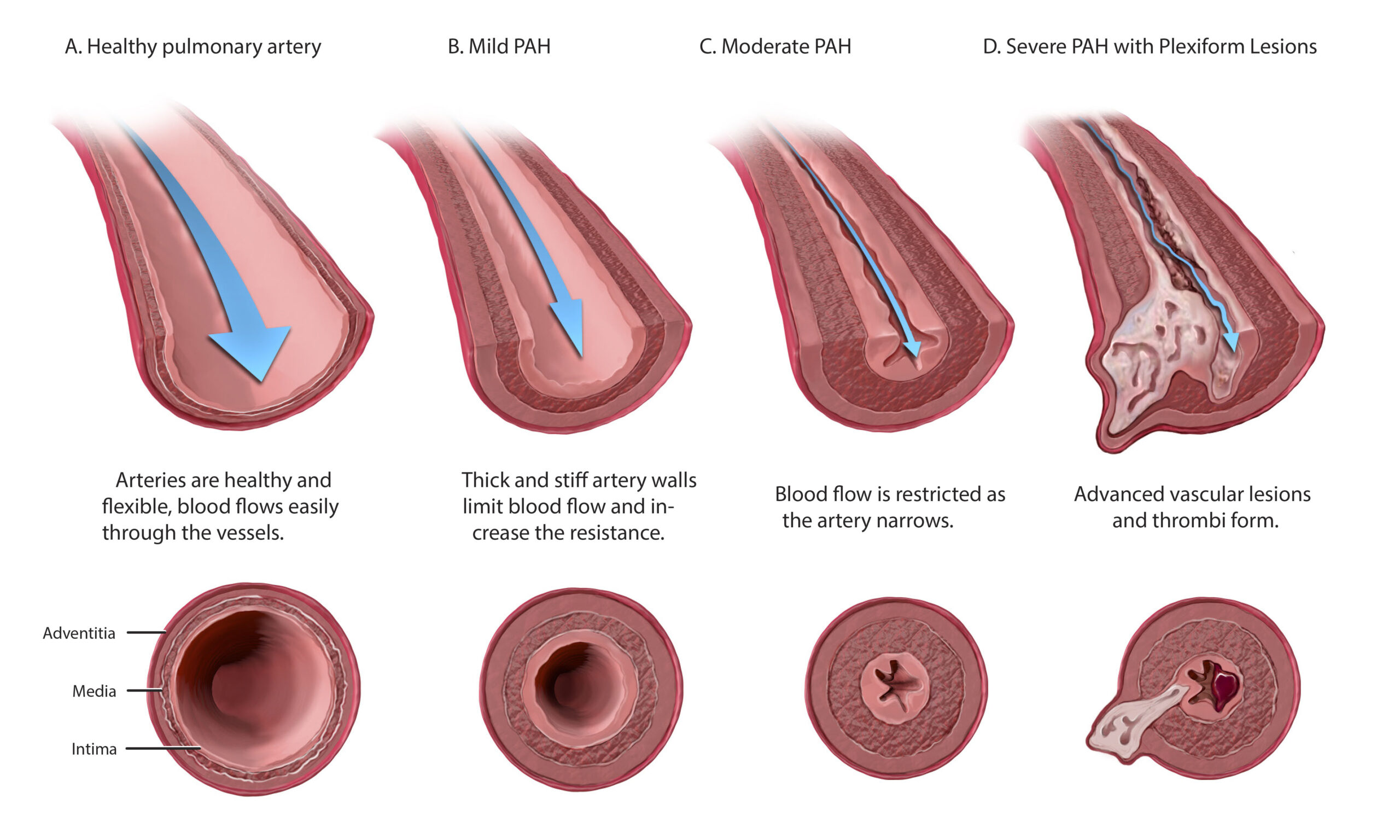
Group 1 refers to pulmonary arterial hypertension, a rare condition caused when the arteries in the lungs become narrowed, thickened and rigid. The right side of the heart must work harder to push blood through these narrowed arteries. This extra stress can cause the heart to lose its ability to pump enough blood through the lungs to meet the needs of the rest of the body.
Some people use the terms PH and PAH interchangeably, but they aren’t the same. All PAH is PH, but not all PH is PAH.
Effects of PAH on healthy arteries
There are several types of PAH and contributing factors:
Idiopathic PAH occurs without a clear cause.
Heritable PAH is linked to genes that are inherited from family members.
PAH that develops in association with other medical conditions including:
- Congenital heart disease
- Liver disease
- HIV
- Connective tissue diseases — such as scleroderma, lupus and Sjögren’s
- Past or present drug use, such as the use of methamphetamine or certain diet pills.
- Schistosomiasis
Did you know inheriting a gene can increase your risk?
Inheriting a gene for PAH increases your risk, but few develop the disease.
Of the small percentage of people who carry a gene associated with PH, few will develop the disease. Genetic testing can help you find out whether you carry one of those genes. Before pursuing genetic testing, discuss the pros and cons with your PH specialist and a geneticist.
Watch the video
Idiopathic PAH
IPAH is a severe disease that is identified when there is a blockage to blood flow through the small arteries in the lungs. It is very rare, with an incidence of approximately 2 to 5 people per million worldwide.
Heritable PAH
HPAH is a form of PAH that is genetically inherited and involves mutations in the BMPR2, ACVRL1 or ENG genes. It may be familial (with a known family history) or sporadic with detectable mutation.
Risk factors for developing Group 1 PAH
Sometimes PAH is related to other diseases and conditions and may be referred to as secondary PAH. These associated diseases or conditions are among those that can increase your risk of developing PAH.
-
Liver Disease
Portopulmonary hypertension is a type of Group 1 PH that occurs as a result of portal hypertension and advanced liver disease.
-
HIV
Human immunodeficiency virus is a chronic infection known to be associated with Group 1 PH or pulmonary arterial hypertension.
-
Lupus
In rare cases, people with the autoimmune condition, systemic lupus erythematosus, develop Group 1 pulmonary hypertension or PAH.
-
Scleroderma
Group 1 pulmonary hypertension affects up to 15% of those with scleroderma, an autoimmune disease that targets connective tissues and blood vessels.
-
Sjögren’s
Sjögren’s is the third most common autoimmune disease and causes inflammation of the salivary, tear and respiratory glands.
-
Meth Use
People who use methamphetamine have an increased risk of heart and lung diseases including Group 1 PH or pulmonary arterial hypertension.
-
Schistosomiasis
Schistosomiasis is a parasitic disease caused by a flatworm present in fresh water sources in the Global South.
-
Congenital Heart Disease
Pulmonary hypertension associated with congenital heart disease can result from various heart and blood vessel abnormalities that develop before a person is born.
-
Eisenmenger Syndrome
Eisenmenger syndrome is a form of pulmonary arterial hypertension caused by congenital heart disease. Eisenmenger syndrome is often diagnosed in adolescents and adults because it develops over time, though it can appear in children if the defect is severe or complex.
PH is a serious disease but there is hope
If left untreated, PH can lead to right heart failure and death. Fortunately, because of major advancements made over the past few decades, therapies that target the pulmonary arteries (PH-targeted therapies) are available to help relieve symptoms, improve quality of life and slow down progression of the disease.
PH treatments